How to Style a White Button-Down
A white button-down has four modes, and knowing them is the whole answer. Worn as a shirt, buttoned and tucked, it is the most formal option. Worn as a layer under a knit, vest, or blazer, only the collar and cuffs show, and it reads as polish rather than as the main piece. Worn open over a tank or tee, it becomes a lightweight jacket. Worn knotted or half tucked, it turns casual. Fit decides which modes a shirt can do: a crisp poplin suits modes one and two, a soft oversized shirt suits modes three and four.
Below: each mode, the fit and fabric variables that decide which ones a shirt can do, and two honest questions most guides skip, transparency and upkeep.
Mode one: as a shirt, buttoned and tucked
The default use, and the one almost everyone already knows. Fully buttoned, tucked in, collar upright, it is a workwear staple because it looks finished with almost no effort. Trousers, a pencil skirt, or a midi skirt all pair with it without friction.
The trade-off is that mode one only works on a shirt with structure. A crisp cotton or poplin holds its shape at the collar and body, so the look stays sharp all day. A soft, drapey shirt goes slack, the collar folds unevenly, and the tuck loosens by midafternoon. That is a fabric problem, not a styling one.

Mode two: as a layer under something
Here the shirt stops being the main piece. Only the collar and cuffs show, peeking out from under a sweater, vest, or blazer, and the effect reads as considered rather than plain. A crewneck knit with a collar underneath looks more finished than the same knit alone, because the collar gives the neckline a hard edge instead of a soft one.
This is where the shirt earns its reputation as the most useful piece in a closet. It pairs naturally with an open cardigan for the same reason, both rely on a visible edge doing the styling work, a mechanic covered in how to style a cardigan. Push the cuffs out past the sweater sleeve and the layering reads as intentional; tuck them fully inside and the shirt disappears.

Mode three: open, as a lightweight jacket
Left unbuttoned over a tank, slip, or tee, the shirt functions as an outer layer. This is the mode that makes a white button-down useful in warm weather, adding shape without the heat of an actual jacket.
The shirt needs a little body for this to work. A stiff poplin holds its own shape when open and drapes like a jacket. A soft or clingy fabric collapses against whatever is underneath, and the outfit reads as an undone shirt rather than a deliberate layer. A longer shirt worn open functions as a jacket; a very short, cropped one does not have enough fabric to do the job.

Mode four: knotted, half tucked, or otherwise casual
The mode built for movement rather than polish. A front knot at the waist, a half tuck, or simply leaving the shirt untucked with sleeves rolled all push the outfit toward casual. The half tuck is worth doing correctly, and the exact mechanic for a clean, even fold is covered in how to do a french tuck.
Soft, lighter fabrics knot and gather more easily than stiff ones, so an oversized cotton or a chambray-style shirt suits this mode. A stiff poplin resists the knot and holds a crease at the tie point long after, which is why mode four and mode one favor different fabrics.

Fit, collar and fabric decide which modes your shirt can do
The biggest variable is not the outfit, it is the shirt. A crisp, structured poplin with a stiff collar suits modes one and two: it holds a tuck and keeps a collar upright under a sweater. A soft, oversized cotton shirt suits modes three and four: it drapes open like a jacket and knots easily, but looks unfinished fully tucked, since it has too much fabric to sit flat.
Neither fit is better. They are different garments that share a silhouette, and most of the frustration comes from forcing one fit into a mode it was not cut for, a soft oversized shirt tucked tight for the office, or a stiff fitted shirt knotted for the weekend.

Sleeves: the free lever nobody uses
Sleeve treatment changes an outfit’s register at no cost. Fully buttoned at the cuff reads formal. Cuffs undone and pushed back once or twice reads relaxed but put-together. Sleeves rolled below the elbow read the most casual, pairing naturally with mode three or four. Treat sleeve length as its own decision rather than leaving it as it came out of the closet.

Bottoms, by how dressed up you want to be
Trousers and tailored pants keep the outfit in mode one or two territory. A pencil or midi skirt does the same. Jeans move the outfit toward casual regardless of mode, though a full tuck still reads more finished than an untucked shirt over them. Wide-leg trousers change the proportion question, since the fitted top now needs to balance a much larger bottom half, a balance worked through in how to style wide leg pants. A denim mini or a flowing maxi skirt both work with a knotted shirt.

Shoes
Shoes shift formality faster than almost any other piece. Loafers or pumps keep a buttoned, tucked shirt in work territory. Sneakers pull the same shirt toward weekend, especially in mode three or four. Sandals with an open, knotted shirt over a tank is a warm-weather staple. Boots work with nearly all four modes and mostly change the season rather than the formality.
The transparency problem, and what to wear underneath
White cotton, especially lighter-weight poplin, is often sheer enough that whatever is underneath shows through, and that is simply a fact about the fabric rather than a defect in any particular shirt. A plain, opaque camisole or tank in a neutral tone keeps the outfit clean in mode one or two. In mode three, the layer underneath is doing real visual work, so a smooth, opaque piece close in color to the shirt keeps the layering intentional. Bright or patterned pieces underneath show through and compete with the shirt.

Color and the all-white outfit
A white button-down is one of the easiest pieces to build an outfit around, since white pairs with nearly everything. The general reasoning is in how to match colors in an outfit, and the shirt-specific note is that white and black is the most common, reliable pairing, covered in what colors go with black. An all-white outfit works too, but only when the whites match in shade and finish; a warm white next to a cool white, or a matte white next to a sheened one, reads as a mismatch rather than a monochrome look.
The honest note on upkeep
A white shirt shows everything, which is a maintenance question, not a styling one. Cotton and cotton-poly blends gray at the collar and cuffs faster than anywhere else on the shirt, and once that graying sets in, no outfit choice fixes it; the shirt needs replacing or a serious wash. Light creasing suits mode three or four, where a rumpled look reads as casual, but modes one and two need a crisp, pressed finish, since unpressed cotton loses its structure. Washing a white shirt separately from dark items is worth the habit.
What tends not to work
A stiff poplin worn knotted. The fabric resists the fold and holds a hard crease at the knot point. Save the knot for a softer shirt.
A sheer shirt over a visibly contrasting layer. A bright or patterned piece shows through white cotton and competes with the shirt. Keep what is underneath plain and close in tone.
An oversized shirt fully tucked into a low-rise bottom. The extra fabric has nowhere to go and bunches at the waistband. Oversized shirts work best left open, knotted, or half tucked.
Two different whites worn together. A warm ivory shirt against a cool bright-white skirt reads as a mismatch rather than an intentional monochrome outfit, even though both pieces are, technically, white.
Steal these formulas
- Work, mode one: crisp poplin shirt, fully buttoned and tucked, tailored trousers, loafers.
- Work, mode two: collar and cuffs showing under a fine knit, midi skirt, block heel.
- Weekend, mode three: soft cotton shirt worn open over a tank, jeans, sneakers.
- Weekend, mode four: shirt knotted at the waist, denim mini or shorts, flat sandals.
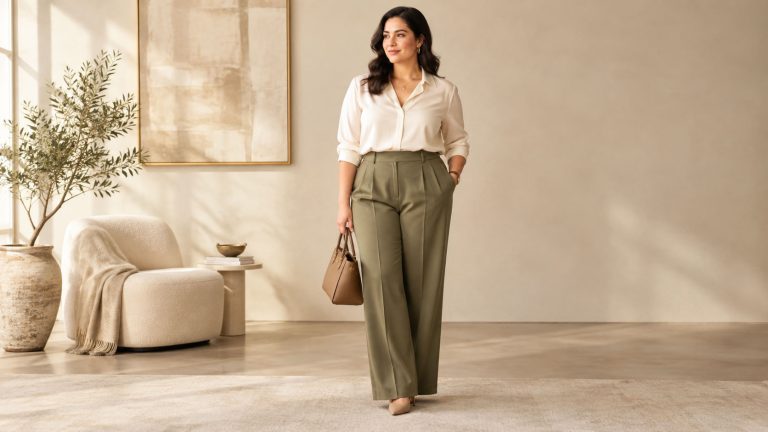
- All-white: matching-tone white shirt and white wide-leg trousers, neutral flats, minimal jewelry.

Quick answer recap
A white button-down is four garments in one: a shirt (buttoned, tucked), a layer (collar and cuffs only), an open jacket (over a tank), and a knotted casual top. Fit decides which of those a shirt can do; a crisp structured poplin favors modes one and two, and a soft oversized cotton favors modes three and four. Sleeve treatment is a free adjustment worth making on its own. White cotton is often sheer, so what goes underneath matters, and a graying collar is a fabric problem no outfit choice fixes.
FAQ
How many ways can you wear a white button-down shirt?
Four. Buttoned and tucked reads formal, worn as a layer reads polished, worn open over a tank reads like a jacket, and knotted or half tucked reads casual. Fit decides which of the four a shirt handles well.
What should you wear under a white button-down if it is sheer?
A plain, opaque camisole or tank in a neutral tone. White cotton is often sheer enough to show whatever is underneath, so a simple layer close in color keeps the outfit looking intentional.
Should a white button-down be tucked or untucked?
Both work; the choice is about formality, not a rule. Fully tucked reads the most polished, suiting trousers or a pencil skirt for work. Untucked, half tucked, or knotted reads casual with jeans or a mini skirt.
Can a white button-down be worn as a jacket?
Yes. Left unbuttoned over a tank or slip, a shirt with some body drapes like a lightweight jacket. Soft or clingy fabrics do not hold that shape and collapse against the layer underneath instead.
Why does a white shirt collar turn gray over time?
Repeated wear and washing wears down white cotton fibers, and the collar and cuffs take the most friction, so they gray first. It is a fabric behavior, not a washing mistake, and no styling choice corrects it once it sets in.