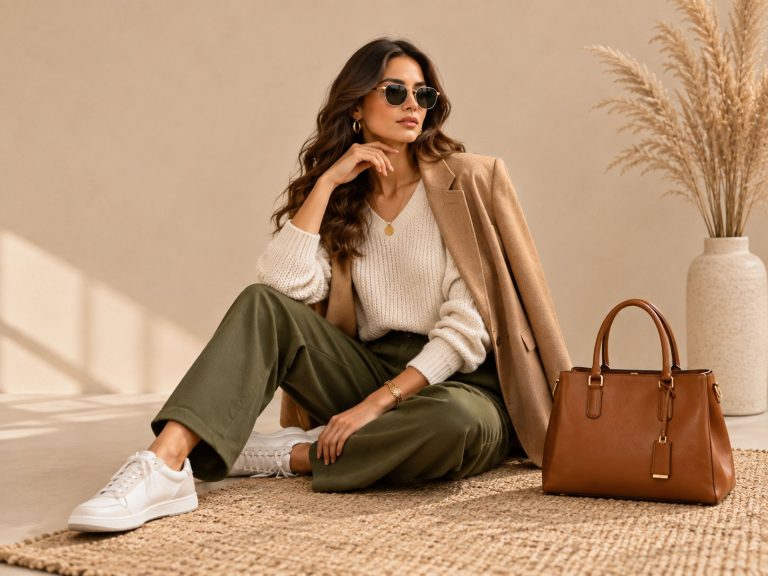
How to Style Wide Leg Pants
Wide-leg pants work when only one part of the outfit carries volume and the waist stays visible. The trousers already own the volume, so the top needs to be fitted, tucked, cropped, or half-tucked, which gives the eye a waistline to read. After that, two decisions do most of the remaining work. The rise sets where the waist sits, so a high rise leaves a long leg line and accepts a wider range of tops, while a mid or low rise needs a shorter or tucked top to compensate. And hem length and shoe height are one decision, not two: full-length hems belong over a heel or a boot, ankle-length hems belong over a flat or a sneaker.
Everything below is that rule applied. No part of it depends on the silhouette being fashionable at any given moment, because proportion mechanics do not change.
Why the rule works
“Balance the proportions” is the standard advice on this topic and it is almost never explained, so here is what is actually being balanced.
An outfit is read by the eye as a set of shapes. When one shape is large and soft, the eye needs a fixed reference point to make sense of the rest, and in clothing that reference point is the waist. It is the only place on the body where the silhouette narrows predictably, so it is where a viewer locates the figure inside the clothes.
Wide-leg trousers are a large, soft shape occupying the entire lower half. If the top half is also a large soft shape, there is no reference point anywhere and the outfit reads as fabric rather than as a person wearing clothes. Height and shape both get lost, which is what people mean when they say wide legs make them look shorter.
Add a visible waist and everything resolves at once. The trousers become a deliberate volume rather than an accident, and the eye reads a defined top half over a full bottom half, which is a shape it recognizes.
So there is one rule with two halves: one volume at a time, and the waist must be findable. A tuck, a cropped hem, a belt, a fitted knit, or a jacket that closes at the waist all satisfy the second half.
The rise sets everything else
Almost no guide on this topic mentions the rise, and it is the variable that determines how much freedom you have with everything else.
High rise. The waistband sits at or near the natural waist, which is the narrowest point, so the waist is already marked by the trousers themselves. The leg line starts higher, which is why high-rise wide legs are the most forgiving version of the silhouette. You can wear a slightly looser top, because the trousers are doing the waist-defining work.
Mid rise. The waistband sits below the natural waist. The waist is not marked, and the leg line starts lower, so the top has to do more: tuck it, crop it, or choose something fitted. A loose top over mid-rise wide legs is the combination that most reliably disappoints, and the rise is usually the reason rather than the top.
Low rise. The hardest with a wide leg, because the outfit has volume starting from the hip with no waist marker at all. It needs a genuinely cropped or fitted top and usually a shoe with some height.
If you own a pair that never seems to work no matter what you put with them, check the rise before you change the top.

Hem length and shoe height are one decision
These are treated as two topics everywhere and they are one.
A wide leg is a straight, unbroken vertical column of fabric. Its job is to run continuously from the waist to the floor, and anything that interrupts that column shortens the whole line. So the hem and the shoe must be chosen together.
Full length with a heel or a boot. The hem should end close to the floor, just skimming the top of the shoe, which hides most of the shoe and lets the column run almost to the ground. This is the longest, most formal version of the silhouette and the reason wide legs and a heel look so effective together.
Ankle length with a flat or a sneaker. The hem ends at or just above the ankle bone, showing the whole shoe and a small amount of ankle. The column stops higher, which is a shorter line, but it is a clean, deliberate stop rather than a puddle of fabric. The sneaker version of this is covered further in what to wear with white sneakers.
The version that does not work: a full-length hem over a flat shoe, where the fabric folds and breaks on top of the shoe and the column ends in a bunch of horizontal creases. This is the single most common wide-leg problem and it is entirely fixable with a hem adjustment.
Practical consequence: a pair of wide-leg trousers is hemmed for a shoe height. If you wear both flats and heels, either accept the compromise or treat the pair as belonging to one of the two.

Tops that work with wide leg pants
- Fitted knit, tucked. The default and the most reliable. A fine rib is particularly good because it has surface interest without volume.
- Cropped knit or tee. Solves the waist question by ending at the waistband. Works especially well with a high rise.
- Fitted tee or tank, tucked. The casual version. Add a belt if the waistband has loops.
- Button-down shirt, tucked or half-tucked. The half-tuck is useful here because a shirt has enough structure to keep its shape while still marking the waist.
- Bodysuit. Guarantees a clean line with no bunching at the waistband, which matters more with a wide leg than with any other trouser.
- Fitted turtleneck. The most streamlined winter option, and it lengthens the visible line above the waist.
Loose and oversized tops are not banned, they simply require the waist to be marked another way, which usually means a belt over the top or a jacket closed at the waist.
On color, wide-leg trousers are a large block of a single color, so they behave like a base rather than an accent. Black and navy are the easiest to build on, covered in what colors go with black and what colors go with navy pants, and the general pairing method is in how to match colors in an outfit.

The third piece
A jacket, cardigan, coat, or waistcoat is what turns wide-leg trousers from comfortable into composed, and it does two things at once: it adds structure, and it gives the outfit a vertical line down each side that offsets the horizontal volume at the hem.
Length matters. A jacket that ends at or just below the waist keeps the waist visible and the leg line long. A jacket that ends at the widest part of the hip adds a horizontal line exactly where the trousers are already widening, which is the least useful place for it. A long, lean coat that runs past the knee works too, because it creates its own column.
Structure matters. A tailored blazer supplies far more definition than a soft, drapey cardigan, so the blazer can carry a looser top underneath while the cardigan cannot. The proportion notes in how to style an oversized blazer are directly relevant, since an oversized blazer plus wide legs is two volumes and needs the waist marked deliberately.

Fabric weight decides how they read
Two pairs of wide-leg trousers in the same cut can read completely differently depending on the fabric, and this is what separates the tailored version of the silhouette from the soft one.
Crisp and structured (wool, wool blend, heavy crepe, twill, denim). The leg holds its shape and falls in a clean line. Reads tailored and formal. This is the version that works at work.
Fluid and drapey (viscose, satin, tencel, fine jersey). The leg follows the body and moves. Reads soft and relaxed, and it is the version that can drift toward looking like sleepwear if the top half is also soft. Structure above becomes non-negotiable.
Light and airy (linen, cotton gauze). Casual and warm-weather by default. Linen creases, which is part of its character rather than a fault, but it does mean the crease is doing some of the visual work.
If a pair of wide legs looks less polished than you expected, the fabric is often the reason rather than the styling.

By occasion
Work. Structured fabric, full-length hem, a heel or a loafer with a small stack, a tucked knit or shirt, and a blazer. This is close to the strongest business-casual outfit available.
Everyday casual. Ankle-length hem, cropped or tucked tee, flat shoe or sneaker, and a jacket or an overshirt for the structure.
Evening. Fluid fabric, full-length hem over a heel, a fitted or cropped top, and minimal accessories so the silhouette leads.
Warm weather. Linen or cotton, ankle hem, a fitted tank or a cropped knit, and a flat sandal with a visible ankle.

When wide leg pants are not the right trouser
Every page on this topic assumes you have to make them work. Three honest cases where a different trouser is simply the better tool.
When the outfit needs a defined lower half. With a long, oversized top that you do not want to belt or tuck, a straight or slim trouser is doing a job the wide leg cannot. This is a styling constraint, not a body one.
When the hem cannot be adjusted. A wide leg hemmed for the wrong shoe height will keep looking wrong. If the pair cannot be altered and does not match the shoes you actually wear, it is not the right pair rather than the wrong silhouette.
In a practical setting. Rain, mud, bicycles, escalators, long days on your feet. A wide hem drags, catches, and soaks. This is a genuine limitation and it is worth saying rather than styling around.
Steal these formulas
- Work: black structured wide-leg trousers, full-length hem, fine knit tucked, tailored blazer, low block heel or loafer.
- Everyday: ankle-length wide-leg denim, cropped tee, white sneakers, denim or utility jacket.
- Evening: fluid black wide legs, full-length over a heel, satin or fitted cropped top, one metallic accessory.
- Warm weather: linen wide legs at the ankle, fitted tank tucked, flat sandal, straw or canvas bag.
- Cold weather: wool wide legs, fitted turtleneck tucked, long coat past the knee, ankle boot with a small heel under a full-length hem.

Quick answer recap
One volume at a time, and keep the waist visible. Since the trousers hold the volume, the top should be fitted, tucked, cropped, or half-tucked. Check the rise first, because a high rise marks the waist for you and a mid or low rise leaves that job to the top. Treat hem length and shoe height as a single decision: full length over a heel, ankle length over a flat, and never a full-length hem breaking over a flat shoe. Add a third piece that ends at the waist or runs past the knee, and let the fabric weight tell you whether the pair is a tailored trouser or a soft one.
For the color side of building an outfit around them, see how to match colors in an outfit.
FAQ
What tops go with wide leg pants?
Fitted or tucked ones, so the waist stays visible. A fine knit, a cropped top, a tucked tee, a bodysuit, or a half-tucked button-down are the most reliable. Loose tops work only when a belt or a fitted jacket marks the waist instead.
What shoes go with wide leg pants?
It depends on the hem. A full-length hem is designed for a heel or a boot, and an ankle-length hem is designed for a flat, a loafer, or a sneaker. The combination to avoid is a full-length hem breaking over a flat shoe, because the fabric bunches and shortens the line.
Do wide leg pants make you look shorter?
Only when the waist is not visible or the hem is the wrong length. The silhouette relies on an unbroken vertical column from waist to floor, so a marked waist and a hem matched to the shoe height keep the leg line long.
Should wide leg pants touch the floor?
Full-length pairs should skim the top of the shoe rather than pool on the floor. Ankle-length pairs should end at or just above the ankle bone. Both are correct; the mistake is a length in between the two.
Can you wear wide leg pants to work?
Yes, and a structured fabric makes it easy. A wool or crepe wide leg with a full-length hem, a tucked knit, a blazer, and a low heel or loafer reads as one of the more polished business-casual outfits available.