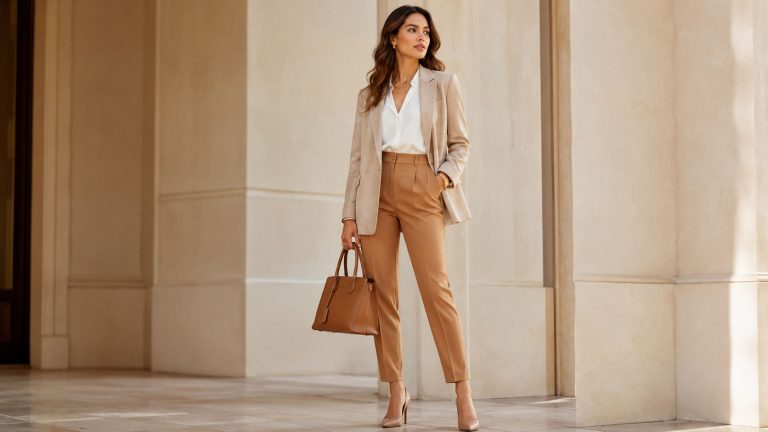
How to Style a Cardigan
A cardigan looks unintentional for one of four reasons, and each has a direct fix. The base layer underneath has bulk, so swap it for something smooth: a fitted tee, a thin knit, a camisole, or a turtleneck. The waist is not marked, so tuck the base layer, front tuck it, belt the cardigan, or button only the middle two or three buttons. The cardigan’s hem lands at the widest point of the outfit, so change its length or the volume underneath. Or every piece is equally soft, so add one structured item: a stiffer shoe, a belt, a tailored trouser, or a structured bag.
Below: each cause in full, then buttoning, gauge, length, and the outfits that follow.
The short answer: four causes, four fixes
A cardigan is open and soft by design, which is exactly what makes it easy to get wrong. When a cardigan outfit does not work, it is rarely the cardigan itself; it is one of four things around it.
- Bulk underneath. A thick base layer doubles the torso’s volume. Fix: a smooth, fitted base layer.
- No waist marker. An open cardigan over an untucked top gives the eye nothing to read as a waist. Fix: tuck, front tuck, belt, or button the middle only.
- Hem at the widest point. A cardigan ending where the hips or thighs are widest draws a line at the least useful spot. Fix: change the length relative to what is underneath.
- Uniform softness. No structure anywhere reads as unfinished. Fix: one structured piece, anywhere.
Most outfits that do not work have two or three of these at once, which is why the fix rarely feels obvious until it is named.
What “frumpy” actually means, defined mechanically
The word that shows up most around cardigans is frumpy, and it is almost never defined. Defined mechanically, it means an outfit has no visible structure and no visible waist. It is not a comment on a person, a body, or an age; it is a description of two missing signals.
A cardigan is the garment most likely to remove both at once, since it is soft by construction and worn open by default. That follows from the garment itself, and it is fixable with the same four causes above. Understood this way, the fix becomes a choice among four things rather than a source of anxiety.
Cause one: the base layer has bulk
A cardigan adds fabric to the torso. If what is underneath is already thick, a chunky sweater or a heavy waffle knit, the two layers combine into far more volume than either alone, and the result reads heavy regardless of the cardigan’s own shape.
The fix is a smooth, fitted base layer: a fitted tee, a thin knit, a camisole, a fine turtleneck, or a bodysuit. It need not be tight, only smooth enough that the cardigan adds shape rather than bulk. This one swap resolves more cardigan outfits than any other change here.

Cause two: the waist is not marked
An open cardigan over an untucked top creates one long line from shoulder to hem, with nothing telling the eye where the waist is, so the outfit reads as a single soft column.
There are four direct fixes, and one of them, the front tuck, is covered in full in how to do a french tuck: tuck the base layer fully, front tuck it, belt the cardigan or the layer underneath, or button only the middle two or three buttons so the opening narrows at the waist.
Any one is usually enough alone. Combining two, a front tuck plus a belt, simply makes the marker stronger.

Cause three: the hem lands at the widest point
A cardigan’s hem is a horizontal line, and horizontal lines draw the eye to wherever they sit. A cardigan ending right at the hip places that line at the widest part of the lower body.
The fix is a different relationship between the cardigan’s length and what is underneath, not a different body. A longline cardigan bypasses the widest point by extending past it; a cropped cardigan bypasses it by ending well above it. The problem belongs to mid length cardigans stopping exactly at the hip, and it is solved by moving the hem.

Cause four: everything is equally soft
If the top, the trousers, and the shoe are all soft with no defined shape, the outfit has no contrast and nothing for the eye to land on. This is separate from bulk or waist marking; an outfit can have a good base layer and a clean tuck and still read unfinished if it is uniformly soft.
The fix is one structured item: a shoe with a defined shape, a stiff belt, a tailored trouser with a crease, or a structured bag. A structured jacket layered with a cardigan does the same job by contrast. Only one piece is needed; two or three and the cardigan looks out of place in its own outfit.
Buttoning: what each option does
Buttoned all the way up, a cardigan reads closest to a shirt and loses layering flexibility. Buttoned only at the middle two or three buttons, it narrows at the waist and opens above and below, the most versatile option for most cardigans. Worn fully open, it creates one continuous vertical line that lengthens the torso, which works over a marked waist and poorly without one, since an open unmarked cardigan removes both signals at once.

By cardigan gauge and by length
A fine gauge cardigan drapes close to the body and layers under a jacket without adding meaningful bulk. A mid gauge cardigan is the most common and flexible. A chunky gauge cardigan adds real volume and needs a fitted base layer and a slimmer bottom; it is not the same garment as a fine gauge one.
By length: a cropped cardigan ends above the waist and works over bottoms of any width, since it never reaches the hip. A hip length cardigan is most likely to hit the widest point and benefits most from a marked waist. A longline cardigan extends past the hip and pairs well with wide leg pants, since both are long, straight lines reading as one silhouette. A duster length cardigan, reaching the knee, functions closer to a coat and is almost always worn open over a fitted base layer.

Bottoms that work with a cardigan
Slim or straight trousers and skinny jeans give a streamlined line under any cardigan and are the safest default with a chunky gauge. Wide leg trousers balance a longline cardigan well. A fitted dress under an open cardigan supplies its own waist marker. A full or A-line skirt pairs best with a cropped or hip length cardigan, since two expanding shapes in the same zone compete rather than balance.
Shoes
A flat shoe keeps a cardigan outfit casual at any length. A shoe with some height or a defined heel adds the structured element a soft outfit often lacks. A boot with a firm shaft does the same job in cold weather and pairs naturally with a longline cardigan.
The cardigan as a top rather than a layer
Buttoned over a camisole or bodysuit with nothing layered further, a cardigan functions as a top. This works best with a fine or mid gauge cardigan, a marked waist, and a bottom with some structure, since a cardigan worn as a top has less coverage than a shirt and needs the rest of the outfit to carry more of the shape.
Making a cardigan work-appropriate
Choose a mid or fine gauge cardigan rather than a chunky one, layer it over a smooth base layer, mark the waist with a tuck or the middle buttons, and pair it with tailored trousers rather than casual denim. A dark or neutral cardigan such as gray extends easily into business casual settings; the reasoning behind pairing gray is in what colors go with gray.
What tends not to work
A cardigan over an equally loose top doubles the bulk problem. Every button done up on a chunky cardigan removes the waist marker and adds bulk at once, the two least useful causes stacked together. A longline cardigan over a full, voluminous skirt puts two expanding shapes in the same zone. A cardigan as the only layer in an otherwise soft outfit leaves cause four unresolved. For a stiffer outer layer that resolves several of these by default, see what to wear with a leather jacket.

Steal these formulas
- Everyday default: fine gauge cardigan, fitted tee tucked in, straight jeans, loafers.
- Longline balance: longline cardigan worn open, wide leg trousers, a fitted camisole, a low block heel.
- Cardigan as a top: mid gauge cardigan buttoned over a camisole, middle buttons only, straight trousers, a structured bag.
- Work-appropriate: gray mid gauge cardigan, tucked fine knit, tailored trousers, loafers.
- Cold weather: chunky cardigan over a smooth turtleneck, straight jeans, an ankle boot with a firm shaft.

Quick answer recap
A cardigan looks unintentional for one of four reasons: bulk in the base layer, no waist marker, a hem at the widest point, or uniform softness. Swap in a smooth base layer, mark the waist with a tuck, a belt, or the middle buttons, pick a length that does not stop at the widest point, and add one structured piece. Match the fix to the gauge and length of the cardigan rather than treating all cardigans as the same garment.
For the color side of the decision, meaning which base layer and which bottom belong with the cardigan you own, the reusable method is in the guide to matching colors in an outfit.
FAQ
How do you make a cardigan look intentional instead of like an afterthought?
Address whichever cause applies: a smooth base layer, a marked waist, a length that avoids the widest point, and one structured element if the rest of the outfit is soft.
Should a cardigan be buttoned or worn open?
Both work. Buttoning only the middle two or three buttons marks the waist while keeping drape above and below it. Fully open creates a long vertical line and works best over an already marked waist.
What tops go under a cardigan?
A fitted tee, a thin knit, a camisole, or a fine turtleneck. The requirement is smoothness, since a bulky top is the most common cause of an outfit reading heavy.
Do all cardigans need a belt?
No. A belt is one of several ways to mark the waist, alongside a full tuck, a front tuck, or buttoning only the middle buttons. Any one is usually sufficient alone.
What is the difference between styling a chunky cardigan and a fine gauge cardigan?
A chunky cardigan adds real volume and needs a fitted base layer and a slimmer bottom to balance it. A fine gauge cardigan drapes close to the body and layers more casually, including under a jacket, without adding noticeable bulk.