How to Dress an Apple Shape, Honestly
Dressing an apple shape comes down to two decisions: where you place the waist of an outfit, and how the fabric behaves as it passes the middle of your torso. The category describes a body that carries weight through the midsection with less waist definition, so a garment with a fixed waist seam often lands somewhere your waist is not. The fix is to choose the waist placement yourself, high under the bust, at your natural waist, low at the hip, or not at all, and to pick fabrics that move rather than cling if you want movement. That is the whole mechanic. There is nothing here about hiding anything, and there will not be.
First, an honest note about this category
The apple label is the loosest of the five commonly used shapes, and it is worth saying so before any styling advice.
The other categories describe a ratio between skeletal landmarks: shoulders against hips, with the waist in between. Apple does not. It describes where soft tissue sits, which means it groups together bodies that look and behave very differently: a straight torso with a full bust, a rounded midsection with narrow hips, a broad ribcage with a defined waist that simply is not the narrowest point. Advice written for “apple” is therefore averaged across bodies that need different things, which is why so much of it feels vague.
That is worth knowing because it lowers the authority of every list you will read on this topic, including this one. Take the mechanics, check them against your own mirror, discard what does not apply.
The rest of the honest framing applies here too. These categories come out of retail and styling rather than anatomy, most people fall between two of them, and ratios change across a life. Body shape is not a health category, and this is a styling site, so you will find no weight, diet, or exercise content on this page. Those are separate subjects and not ours.
Decision one: where the waist of the outfit goes
This is the lever that changes an outfit most, and there are four positions. None of them is correct. Each does something different.
| Waist placement | What it does | Feels like |
|---|---|---|
| Empire, just under the bust | Sets the break high, so the section below reads as one long fall of fabric | The most fabric movement, the least pressure anywhere |
| Natural, at the narrowest point of your torso | Creates the strongest contrast in the outfit, wherever your narrowest point actually is | Defined; needs the garment’s seam to land where your waist is |
| Low, at the hip | Long torso read, straight column above, break down low | Relaxed, and easy in a shift or a drop-waist cut |
| None, a straight column | No horizontal break at all, one continuous vertical read | The calmest option and the least fussy |
The mistake in most ready-to-wear is not that a waist exists, it is that the waist is fixed in a place that does not match you. A wrap or a tie lets you set the position yourself, which is why wrap dresses appear on every apple list ever published. The underlying reason is placement control, not the wrap itself.
For a reversible version with separates, the front tuck sets a break at a chosen height with nothing pressing on your waist at all. On days when a waistband is uncomfortable, that alone solves the outfit.

Decision two: how the fabric behaves
Fabric does two separate things, and the genre collapses them into one loaded instruction about “clingy” fabrics.
Drape. Fluid fabrics hang from the widest point they touch and fall past everything below it. Stiff fabrics hold their own shape and stand away from the body. Both are useful. A fluid fabric gives movement and a long line. A stiff fabric gives architecture, and a structured A-line or a firm shift reads as a deliberate shape rather than a body outline.
Grip. Some knits and synthetics hold static and catch on the body, so the garment stops moving with you and starts mapping you. That is a comfort and function issue as much as a visual one, and it is worth naming plainly: a garment that rides up all day is annoying regardless of what it looks like. A lining, a slip, or a fabric with a smoother face solves it.
Notice what that reframe removes. “Avoid clingy fabric” tells you your body is the problem. “This fabric grips and rides up, this one moves” tells you what will happen, and lets you decide whether you mind.

The vertical line, and why it keeps coming up
Anything running up and down the torso gives the eye a long path to follow: an open cardigan or jacket, a front placket, a column of buttons, a V or scoop neckline, a long necklace, a monochrome outfit.
This works, and it is worth using when you want a long calm read. It is also the most over-prescribed piece of advice in the category, usually attached to language about lengthening or narrowing. Stripped of that, it is simply a tool: vertical detail leads the eye along the body, horizontal detail leads it across. Choose whichever you want on a given day.
An open longline cardigan is the cheapest version, and it does double duty by adding structure at the shoulder. Our cardigan styling guide covers how to keep that from reading as shapeless.

Necklines and the upper third
Necklines matter here for a real reason rather than a diversionary one: the upper third of an outfit is where most of the detail is visible in conversation, and a neckline is the frame around your face.
- Open necklines (V, scoop, square, wide) show the collarbone and give the top of the outfit an airy read.
- High and closed necklines stack visual mass at the top of the torso, which is a strong, quiet look and works particularly well in a single color from neck to hem.
- Collars add structure and a horizontal at the shoulder, which is useful when you want the shoulder line to read wide.
If you like a high neck, wear a high neck. The instruction to avoid them entirely is one of the pieces of category advice that does not survive contact with real outfits.
Bottoms and the leg line
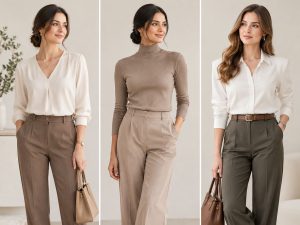
For a body carrying its width through the middle rather than the hip, bottoms often fit more easily than tops, which is a genuine advantage worth using.
- High rise, straight or wide legs put the waistband above the fullest part of the midsection and give a long uninterrupted leg line. This is the most recommended combination in the category for a mechanical reason: the break is high and the line below it is unbroken.
- Mid rise sits below the fullest point, which some people find far more comfortable and which reads with a lower break.
- Structured waistbands hold their position. Elastic and pull-on waistbands move with you and never gape, at the cost of sitting where they like.
- Fluid trousers in a drapey fabric read long and cost nothing in comfort.
Comfort is a legitimate deciding factor, not a compromise. A waistband that presses is one you will spend the day adjusting, and an adjusted outfit never looks composed.
Dresses that give you the placement control
Everything on the usual list is on it for the same reason. Here is what each one is actually doing.
- Wrap: you set the waist height and the tightness yourself.
- Empire: the break is fixed high, and everything below falls.
- Shift: no break at all, a straight column, structure from the fabric.
- A-line: a light break at the top and a widening line below it, so the hem is the widest visible point of the garment.
- Fit and flare with a soft waist seam: definition without a hard fixed line.
If a category of dress has never worked for you, check where its waist seam lands before deciding the category is wrong.

What we are not going to say
The published advice for this shape leans harder on concealment language than any other: disguise, camouflage, draw attention away, minimize. Read a few of those pages in a row and the message is unmistakable, that the middle of your body is a problem the clothes are there to solve.
We are not writing that, and not only for politeness. It is bad styling advice. Advice built on hiding produces outfits organized around a negative goal, which is how people end up in a wardrobe of loose dark tops that they do not particularly like. Advice built on effects, this cut does this to the line, this fabric does that, produces outfits you actually chose.
You are allowed to want a defined middle, a fitted knit, a belt, a bright color at the waist, or a print across the widest part of you. Those are all achievable with the mechanics above, pointed where you want them. The same principle runs through our guide to dressing for your body shape and the underlying page on balancing proportions in an outfit.

FAQ
What is an apple body shape?
It is a styling category describing a body that carries weight through the midsection, with the waist less defined than the bust or hips. It describes soft tissue distribution rather than a skeletal ratio, which makes it the loosest of the five common categories and the one that groups the most different bodies together.
Do I have to hide my midsection?
No, and this site will not tell you to. The useful mechanics are where the outfit’s waist sits and how the fabric moves. Both are effects you can point in whatever direction you want, including toward a defined or emphasized middle.
Which waist placement should I choose?
Try all four: under the bust, at your natural waist, low at the hip, and none at all. Each produces a different silhouette and different comfort. A wrap or tie garment lets you test natural-waist placement without buying anything, since you set the height yourself.
Are fitted clothes off limits?
No. The real questions are whether a fabric grips and rides up, which is a comfort issue, and whether you want a fitted read that day. A lining, a slip, or a smoother knit removes the riding-up problem, after which fitted is a preference like any other.
Does body shape have anything to do with health?
Not for our purposes. This is a styling site and body shape is a retail and styling shorthand, not a health category. You will find no weight, diet, or exercise advice here, and any health question belongs with a qualified professional rather than a fashion page.