How to Make an Outfit Look More Expensive
An outfit reads as expensive when it fits, when it is in good condition, and when its pieces look chosen together. That is nearly the whole answer, and none of it requires buying anything. A pressed shirt with a hem that hangs straight, shoes with an intact heel, and a color story that repeats will read as considered. A brand new garment with a crumpled collar, a sagging hem, and scuffed shoes will not. Cost is invisible at conversational distance. Fit, care and coherence are visible from across a room, and they are what people are actually reading.
The three signals, ranked by how far away they are visible
People read an outfit at a distance before they read any detail. That order matters, because it tells you where effort pays.
| Signal | Visible from | What it is made of |
|---|---|---|
| Silhouette and fit | Across a room | Where the shoulder seam sits, whether the hem hangs level, whether the waist sits where it should |
| Condition | A few paces | Pressing, pilling, hem integrity, shoe heels, hardware, loose threads |
| Coherence | Conversational distance | Colors that repeat, metals that repeat, one clear focal point |
| Material quality | Arm’s length or by touch | Fiber, weave, drape, lining |
The genre spends most of its time on the bottom row, which is the least visible and the only one that reliably costs money. Work from the top down instead.

Fit is the whole first row
Fit is not the same as tight. Fit means the garment’s structural points land on your structural points.
- The shoulder seam should sit at the outer edge of your shoulder, not down the arm. This is the single hardest thing to alter and the easiest to check, which makes it the first thing to look for in anything structured.
- The hem should hang level, and pants should break where you intend rather than pooling. A hem taken up is one of the cheapest alterations available and changes how a garment reads more than almost anything else.
- The waist should sit where the garment thinks it does. A waist seam riding above or below your actual waist is why some dresses never look right no matter what you add to them.
- Sleeves should end where you want the stop. A sleeve half an inch too long looks like the wrong size. The same sleeve rolled to the forearm looks deliberate.
If you can only alter one thing in your wardrobe, alter the piece you wear most often, not the most expensive one. Frequency beats value here.

Condition is where most of the gap actually is
This is the section the roundups skip, because there is nothing to link to in it. It is also where the largest, fastest improvement lives for almost everyone.
Run this as an audit on the clothes you actually wear:
- Press or steam. A creased collar and a wrinkled placket undo good fit instantly. Anything folded in a drawer needs a minute of attention before it goes on.
- De-pill knits. Pilling at the underarm and the side of the torso is the single most reliable low-cost signal, because it is a wear indicator rather than a price indicator.
- Check every hem and seam. A dropped hem, a split seam under the arm, or a thread pulling at a buttonhole reads as neglect from several feet away.
- Look at your shoes from behind. Worn down heel tips are visible when you walk away and invisible to you in a mirror. Re-tipping is routine cobbler work.
- Replace missing and mismatched buttons, and re-secure loose ones before they go.
- Check hardware. Tarnished zip pulls and buckles, and a bag strap with a curling edge, all show at close range.
- Clip loose threads, including the tack stitch holding a vent or a pocket closed on new garments, which is meant to be removed and frequently is not.
None of that costs anything beyond time and, occasionally, a small repair. All of it is more visible than the fiber content of what you are wearing.

Coherence: making the pieces look chosen together
An outfit reads as expensive when its elements look like they arrived together. Three habits do most of that.
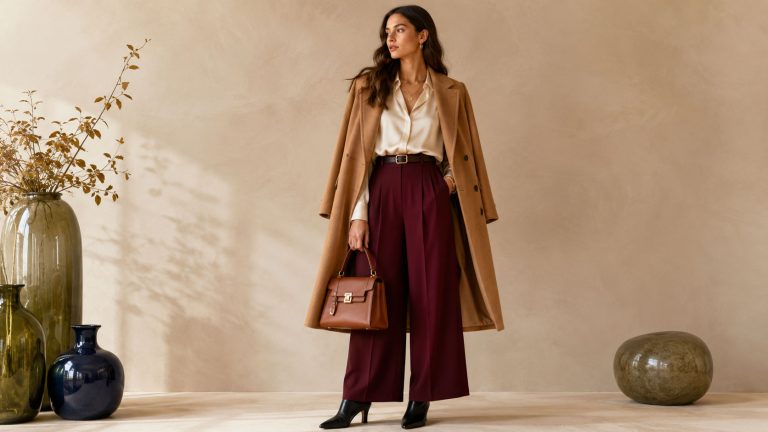
Repeat something. A color that appears twice, at the shoe and the scarf, or the shirt and the trim of a bag, tells the eye the outfit was assembled rather than grabbed. The same logic governs whether shoes and a bag have to match, where the modern answer is that they should relate, not match.
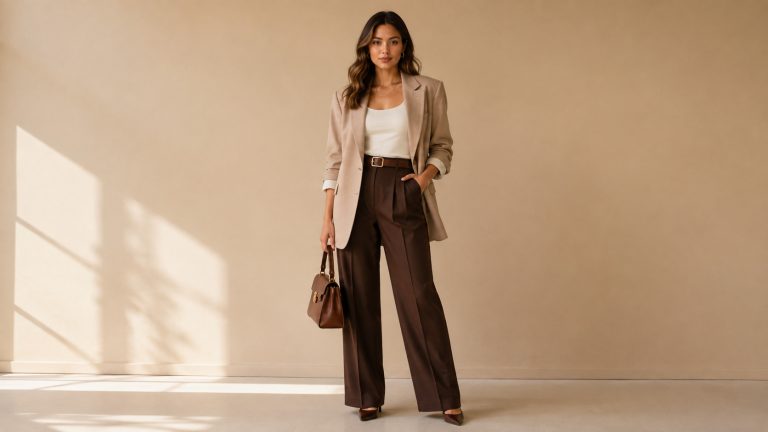
Stay in one color family, or a narrow one. A column of one color, or one color plus a neutral, is the fastest route to a considered outfit, because it removes the horizontal breaks that make a mixed outfit look busy. The full reasoning sits in the color matching guide.
Give the outfit one focal point. One thing should be the loudest: the coat, the shoe, the earrings, the print. Two competing focal points read as indecision. Jewelry follows this too, and the count rule in mixing metals is the same idea applied to hardware: repetition reads as a choice, a single outlier reads as an accident.

Proportion does more than fabric does
A well proportioned outfit in ordinary fabric will beat an expensive fabric hung badly, because silhouette is read first and from furthest away. A defined break at the waist, one volume against one close line, and a hem that lands where you meant it are all free.
That is the connection between this page and the proportion rule: everything in that article is also an answer to this question. The same is true of layering without bulk, since a clean layered outfit reads as effort and a bunched one reads as haste.

The finishing habits that read as intentional
Small, repeatable, and free:
- Tuck, or half tuck, on purpose. An untucked shirt with a straight hem is a choice; a shirt half caught behind a waistband is not.
- Roll sleeves to a consistent point, usually the mid forearm, and roll both the same.
- Do up or leave open the same buttons every time on a jacket, rather than deciding at the door.
- Carry the bag one way. Switching a strap around mid outfit changes the whole balance.
- Let the shoe finish the line rather than interrupt it. A shoe close to the color of the leg or the hem extends the line; a strongly contrasting shoe stops it, which is fine when the stop is the point.

What this cannot do, honestly
Styling cannot create drape. How a fabric falls is a property of fiber and weave, and no amount of pressing turns a stiff synthetic into something fluid. If a garment holds a hard shape you did not ask for, that is the fabric talking and no trick overrides it.
It cannot fix cut either. A garment cut for a different ratio than yours will pull or gape whatever you put with it, and the answer there is alteration or a different cut. Fit first, everything else second.
And a fair warning about the premise: “expensive looking” is a moving target that different rooms judge differently. The version worth chasing is not the appearance of money, it is the appearance of care, because care is the part you actually control and it holds up in every room. This site does not recommend products or list prices, so nothing here depends on you buying anything.
A ten minute version
If you have one outfit and ten minutes: steam the top layer, check the hem and the shoulder seam, de-pill anything knitted, wipe and check the heels of the shoes, remove one competing focal point, and make sure a color repeats somewhere. That sequence is most of what separates the same clothes on two different days.

FAQ
What makes clothes look cheap?
Poor condition, mostly, and poor fit second. Pilling, a dropped hem, visible creasing, worn heel tips and loose threads all read from several feet away, while the fiber content of a garment does not. A well kept inexpensive garment routinely reads better than a neglected costly one.
Does buying more expensive clothes actually help?
Only to a point, and later than people expect. Fit, condition and coherence are read first and from further away. Spending on alterations and repairs for the clothes you already wear usually changes an outfit more than adding a new garment does.
Is monochrome really the easiest way to look put together?
It is the most reliable, because a single color family removes the horizontal breaks that make an outfit look busy and gives you one long uninterrupted line. It also removes the need to make any color decisions, which is why it works on the days you have no time.
Which alteration is worth doing first?
Hemming, on whichever garment you wear most. A level hem at the right length changes silhouette immediately and is one of the simplest alterations a tailor performs. Shoulders are the alteration to avoid, since they are complex and expensive on most garments.
Do accessories make an outfit look more expensive?
They can, but only when they are consistent with the rest of it. One clear focal point and one repeated element read as deliberate. Several competing statement pieces read as noise regardless of what any of them cost.