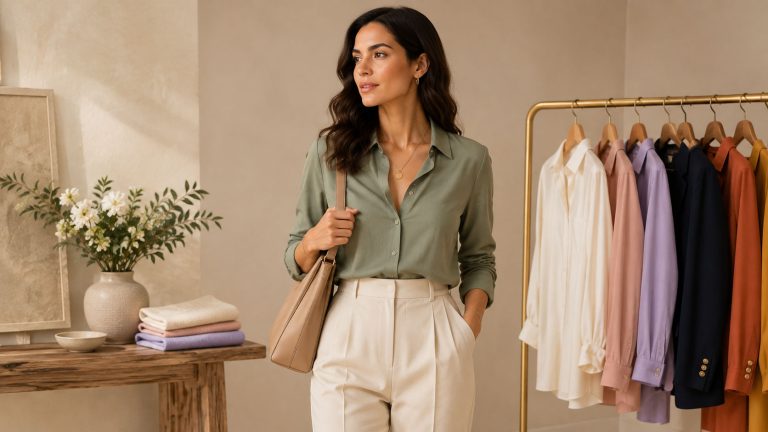
How to Dress a Pear Shape: Balance, Not Concealment
A pear shape means the hip line is wider than the shoulder line, with a visible waist between them. Essentially every styling tip written for it does one thing: it widens the shoulder line so the two ends of the outfit read closer in width. Structured shoulders, puff sleeves, a wide neckline, a bright top with a plain bottom, a statement earring, all of them are that same mechanic in different clothes. Knowing it is one mechanic rather than twenty rules means you can apply it with anything in your closet, and it also means you can decide not to, which is a legitimate choice nobody offers you.
The mechanic, stated once
Balance in an outfit is a comparison. The eye reads the widest point at the top against the widest point at the bottom, and it registers the difference between them. You have two levers, not one.
Lever one: add width at the shoulder. A shoulder seam with structure in it, a sleeve with volume, a wide or horizontal neckline, a top in a light or bright color, a print concentrated above the waist. All of these enlarge the upper read.
Lever two: reduce the attention at the hip. A plain, darker, matte bottom half with no pockets, no detail, and no contrast at the hip. Fewer things stopping the eye down there.
Most published pear advice uses both at once, which is why the resulting outfits all look the same. In practice, one is usually enough, and lever one is the more interesting of the two, because it adds something rather than subtracting it.

The alteration that outperforms every styling tip
Here is what the retailer guides do not lead with, because it does not involve buying a new garment.
A pear ratio means the difference between your waist and your hip measurement is larger than the difference most ready-to-wear bottoms are cut for. So pants and skirts that fit over the hip gape at the back of the waistband. That gap is what makes an otherwise good outfit look wrong, and no amount of upper-body volume fixes it.
Taking in a waistband is routine work for a tailor, usually done through the center back seam, and it is one of the more affordable alterations. If you have been assuming your bottoms are the wrong size, they may simply be the right size in the hip and the wrong shape at the waist, which is a different problem with a real fix.
Two other things follow from the same ratio:
- Buy for the widest measurement, alter the rest. This is standard advice for any body whose ratio sits outside the cutting standard, and it is cheaper than repeatedly buying bottoms that never quite work.
- Stretch is not a substitute for cut. A stretch waistband will not gape, but it also will not sit still, and it tends to roll. Comfortable, but a different trade.

What actually adds width at the shoulder
Working from most to least reliable:
| What to use | Why it works | Worth knowing |
|---|---|---|
| Structured shoulder seam | Sets a hard outer edge at the shoulder, so the top reads at its full width | The strongest lever available, and the reason a blazer changes an outfit so fast |
| Wide or boat neckline | Draws a horizontal line across the collarbone | Also opens the neck, which reads as ease rather than effort |
| Volume in the sleeve | Adds width just below the shoulder line | Full sleeves at the wrist do the opposite, since the width lands at the hand |
| Color or print above the waist | Attention is width, visually | A patterned top with a plain bottom is the same move as a bright top |
| Horizontal detail at the chest | Yoke seams, chest pockets, a horizontal stripe | Only the top few inches; lower down it lands at the waist instead |
| Earrings and a strong hairstyle | Adds visual mass above the shoulder line entirely | Small effect, but free |
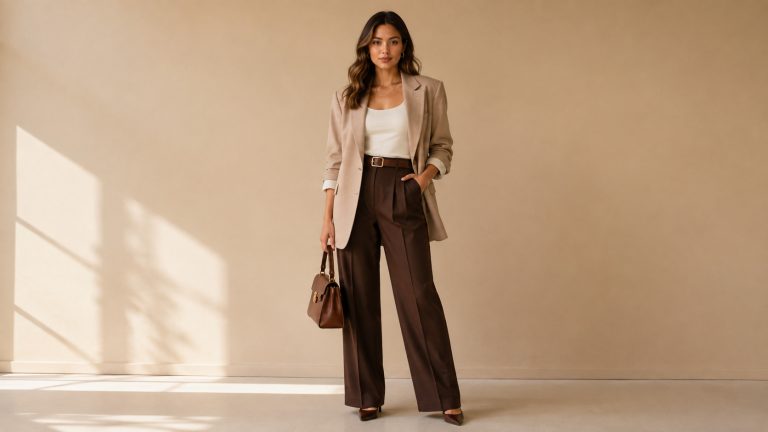
An open jacket does two jobs at once: it puts structure at the shoulder and draws two vertical lines down the torso.
When to reverse the whole thing
Now the part the genre leaves out. Balance is the goal the rules assume. It is not a requirement.
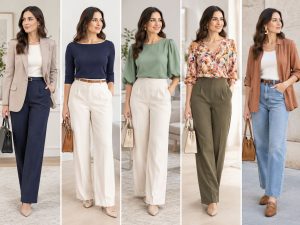
If you want your hip line to be the shape of the outfit, use the same mechanics pointed the other way. Put the color, the print, and the volume on the bottom half. Keep the top narrow and plain. Wear the full skirt with a fitted top and let the skirt be the point. Choose a bottom with detail at the hip if the detail is one you like.
There is nothing corrective about balance, and nothing wrong with an outfit that reads as strongly hip-led. Many silhouettes with long histories do exactly that. The mechanics are neutral tools, which is the point made throughout our guide to dressing for your body shape: the rules describe an effect, and choosing the effect is your job, not the chart’s.

Bottoms, by what the cut does
Not a list of what to avoid. A list of what each cut does, so you can pick the effect you want.
- A-line skirts move away from the body below the waist, so the hip is not the widest visible point of the garment; the hem is. A long, calm line.
- Straight and wide legs run at one width from hip to hem, so the leg reads as a single column rather than tapering to a narrow ankle. The styling for this is covered in how to style wide leg pants.
- Tapered and skinny cuts end narrow, which makes the hip the widest point of the line by comparison. Some people want that contrast, some do not.
- High rise moves the horizontal break up, which lengthens the leg section and puts the waist definition where the waist actually is.
- Flat fronts, no hip pockets, minimal hardware keep the eye moving rather than stopping it at the hip. Patch pockets at the hip do the opposite, which is useful when you want the opposite.
- Fluid fabrics hang from the widest point and skim past everything else. Stiff fabrics hold their own shape, which is a strong, architectural look and a deliberate one.
The waist question
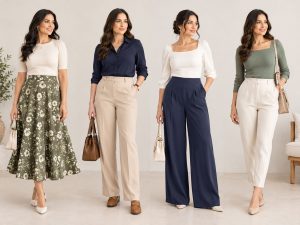
A pear ratio usually comes with a visible waist, so the honest note is that you do not have to do anything special to have one. Emphasizing it, with a belt, a wrap front, or a tucked top, increases the contrast between waist and hip, so it is a choice about how much contrast you want rather than a correction.
The lowest effort version is the front tuck, which sets the break at the waist without anything pressing on it. On a day when a belt is uncomfortable, that is the whole solution.
Dresses
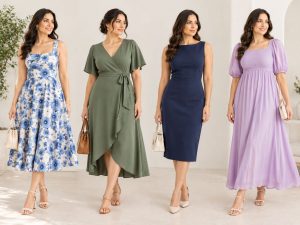
One-piece garments remove the waistband gape problem entirely, which is why many people with this ratio find dresses easier than separates.
- Fit and flare and A-line shapes fit the narrowest part and release below it, which is why they appear on every pear list ever written.
- Wrap dresses let you place the waist yourself, which matters when a fixed waist seam never sits where your waist is.
- Column and sheath shapes follow the body’s own line and read as long and quiet. They need the hip measurement to be the fitting point, and often need the waist taken in.
- Empire lines put the break under the bust and release everything below it, which is a completely different silhouette and worth trying if the natural-waist styles all feel the same.
What this page is not
This is styling, not a health topic. Nothing here is about changing your body, and the difference between a hip and a shoulder measurement is not a medical fact, a fitness goal, or a problem. Body shape categories are a retail shorthand rather than a taxonomy, most people sit between two of them, and ratios change over a life. If the pear advice mostly fits you but the waist part does not, take the parts that apply and leave the rest.
For the mechanics underneath all of this, including break placement and volume, see balancing proportions in an outfit.
FAQ
How do I know if I have a pear shape?
If your hip line is noticeably wider than your shoulder and bust line, with a waist visible between them, that is the pear bucket. It describes a ratio, not a size, so people of very different sizes share it. Plenty of people sit between this and another category, which is normal.
Do I have to balance my shoulders and hips?
No. Balance is the default the conventional rules aim for, and it is one option among several. If you would rather the hip line be the strongest part of the outfit, use the same mechanics in reverse: put the color, print and volume on the bottom half.
What is the single most useful change?
For most people it is having a waistband taken in on the bottoms that already fit at the hip. A ratio outside the cutting standard means gaping at the back of the waist, and that gap undermines the outfit far more than any styling choice.
Are skinny jeans wrong for a pear shape?
No. A tapered leg narrows toward the ankle, which increases the contrast with the hip. That is an effect, not an error. Wear them with something that adds width at the shoulder if you want less contrast, or wear them as they are if you like the line.
Can I wear a print on the bottom half?
Yes. Print on the lower half draws attention there, which is only a problem if you did not want that. Choose based on where you want the eye, not on a rule about which half is allowed to be interesting.